
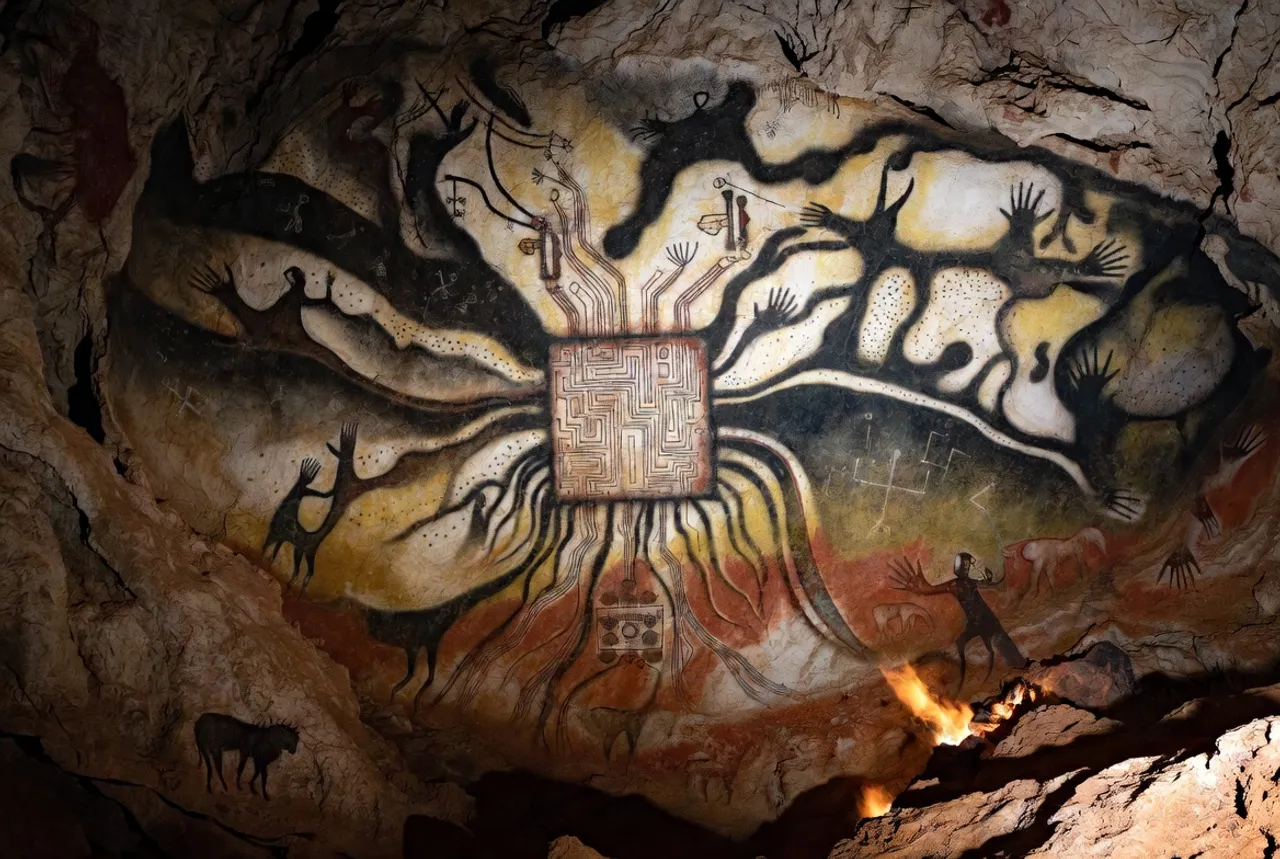
From Cave Walls to Neural Nets: Why AI Is the Latest Chapter in Humanity’s Cultural Story
For tens of thousands of years, humans have been inventing new technologies to record, preserve, and share our collective experiences, stories, knowledge, and dreams. Each breakthrough didn’t just store information — it changed what was possible for the next generation.
AI is not a break from this story. It is the next chapter.
A 45,000-Year Timeline of Recording Culture
Here’s how we got here:
-
~45,000–30,000 years ago — The earliest known figurative cave paintings appear. In Sulawesi, Indonesia (~43,900 years old) and Chauvet Cave in France (~36,000–30,000 years ago), humans created sophisticated visual stories of animals, hunts, and symbolic meaning. These represent the oldest surviving records of human imagination and shared culture.
-
~20,000–10,000+ years ago — Petroglyphs (stone engravings) and rock art spread across the world. Durable carvings of rituals, animals, and celestial events created more permanent, place-based cultural memory.
-
~3500–3000 BCE — The first true writing systems emerge: Sumerian cuneiform in Mesopotamia and Egyptian hieroglyphs. For the first time, humans could precisely record laws, histories, literature, and administration.
-
~105 CE — Paper is invented in China. This lightweight, portable medium eventually replaced papyrus and parchment, dramatically expanding who could create and access recorded knowledge.
-
~1440–1455 CE — Johannes Gutenberg develops the movable-type printing press in Europe. Mass book production begins, sparking the Renaissance, Reformation, and Scientific Revolution by making ideas widely reproducible.
-
1837–1844 — The electric telegraph (perfected by Samuel Morse) allows near-instant long-distance communication for the first time.
-
1876 — Alexander Graham Bell patents the telephone, enabling real-time voice conversations across distances.
-
1969–1991 — ARPANET evolves into the internet. Tim Berners-Lee creates the World Wide Web, giving humanity a global, hyperlinked system for publishing and accessing collective knowledge.
-
1991–Today — Billions of people have filled the internet with writing, images, video, music, code, and conversation — creating the largest accumulation of human culture in history.
AI Is Simply the Next Step
Every technology on that timeline extended our ability to record, remember, share, and remix what came before. AI continues that exact trajectory.
It is not an alien intelligence. It is mathematics — built by humans — applied to the vast digital record of human culture. Large foundation models are trained on text, images, code, music, and conversations created by billions of people. They compress those patterns and make new recombinations possible at a speed and scale never seen before.
In short: we used computers and math (both human inventions) to give ourselves better access to the whole of human knowledge and creativity.
Cumulative Culture Is What Actually Matters
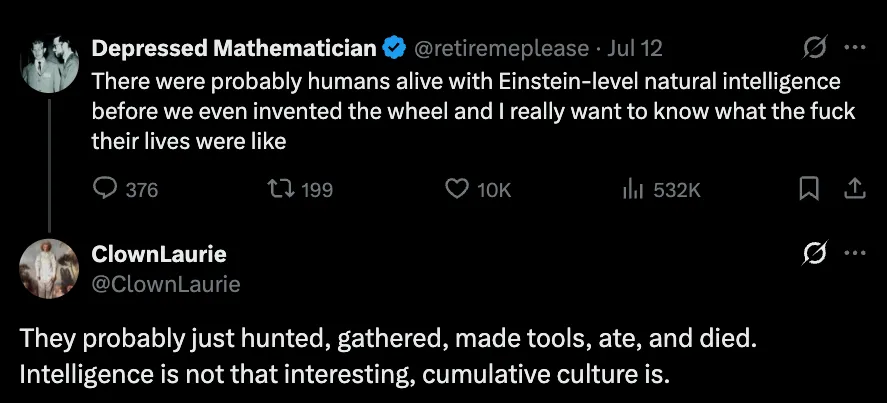
The exchange above captures something profound. One user imagines what an extremely intelligent person from the distant past could achieve. The sharpest reply is this:
“Intelligence is not that interesting. Cumulative culture is.”
This is why AI feels so powerful right now. Had something like it been invented 10,000 years ago, before writing or the printing press, it would have been as limited as a genius born before the wheel. Newton and Einstein didn’t just have big brains — they stood on an enormous ladder of accumulated knowledge built by everyone who came before them.
AI works today because we finally built the infrastructure (the internet) that captured and connected humanity’s collective output. It can now remix and extend that culture at unprecedented speed.
So Is AI Good or Bad?
Like every previous technology on the timeline, AI will be disruptive. The telegraph displaced skilled Morse code operators. The telephone created new jobs while making others obsolete. Computers did the same on a larger scale. This pattern of creative destruction is painful in the short term but has consistently expanded human capability over centuries.
AI will almost certainly eliminate some jobs and transform others. It will also create new categories of work we can’t yet imagine — just as previous technologies did. More importantly, it gives individuals and small teams access to knowledge and creative tools that were previously available only to large institutions or experts.
The real question isn’t whether AI is “good” or “bad.” It’s whether we will use this new layer of cultural technology to build on the best of what humanity has already created.
We’ve been doing exactly that for 45,000 years. AI is simply the latest tool in that ancient, very human project.